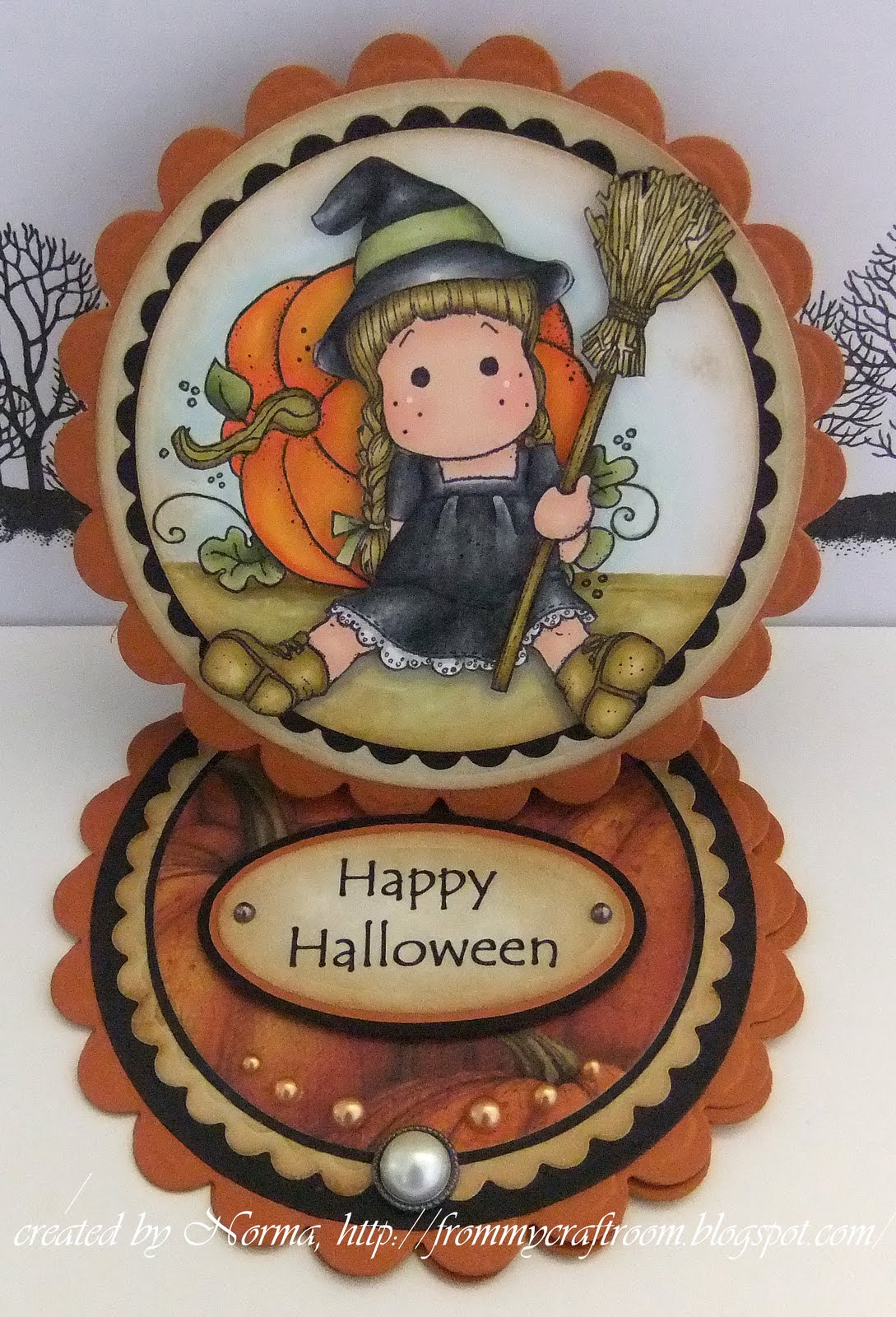
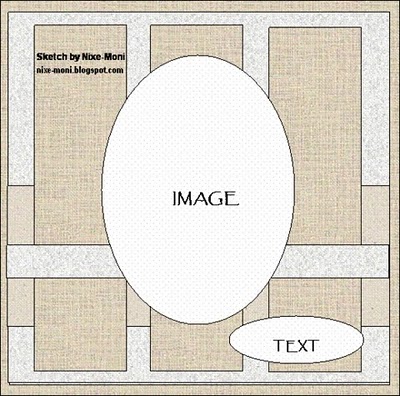
I have to mention first, as I did with my first mini round easel card below, that I saw this at Marianne's blog. However she didn't give any instructions as how to make it, so I had to figure this out. So, this is how I made mine.
I have lots and lot of pictures here--it's easier to show you, as sometimes I don't know how to explain very well.
I created this Christmas card for the tutorial, so I'll just take you through the steps.

 Materials and tools:
* Cardstocks,
* A die-cutting machine--I have a Big Shot.
* Various die cuts. These are the Spellbinders Nestabilities that I used:
Classic Scalloped Circles Large - largest size,
Standard Circles Large - largest and 2nd largest sizes,
Petite Scalloped Circles Large - 2nd largest size,
Small Classic Inverted Scalloped Circles - largest size.
*To decorate your card: Designer paper, coloured image(s), sentimen (s), 1 large brad is mandatory, other embelishments are optional--decorate any way you want.
You need a cardstock that is wide enough to accomodate your die cut. For the one I used--it's largest scalloped circle that I have--that's about 4 1/2 inches wide.

Score at 4 1/2 inches from the top and fold.

To cut out the card, there are 2 ways that I've used of placing your die cut.
(I use removable tape to secure my die cut to the paper--they tend to move around if you don't.)
This is placement no. 1 (the fold will be uncut through 2 arches)

as seen from the other side.

This is placement no. 2: (the fold will be uncut through 3 arches)
 and as seen from the other side
I have used both placements and they both work well. For this particular card, I have used the 2nd one.


Open the card and score midway the top section. Make sure that this is exactly half way...

so that when you fold it down, the scalloped edges of the top half should match the scalloped edges of the bottom half exactly.

This is the base of your easel card.


Open the card and score midway the top section. Make sure that this is exactly half way...

so that when you fold it down, the scalloped edges of the top half should match the scalloped edges of the bottom half exactly.

This is the base of your easel card.

Cut out 2 scalloped circles--same size of your card base, use the same die cut. These are full circles--not cut off at the top.


Place one of the full scallopped circles over the glue--make sure all the scallop edges match, top to bottom.


Place some glue on the front half of the folded section of the easel card base.

Place one of the full scallopped circles over the glue--make sure all the scallop edges match, top to bottom.

And voila, there you have your easel card!

Now you can go ahead and start decorating it.

Now you can go ahead and start decorating it.
Figure out how you're going to decorate this and from other cardstocks and/or designer papers, cut out as many inner circles, scalloped circles or other shapes, as many or as little as you want. The ones that I used are listed above.

I started with decorating the bottom section of the easel card first.


I started with decorating the bottom section of the easel card first.
The next set of instructions is how I dealt with having the back of the brad NOT showing at the bottom of your easel card.
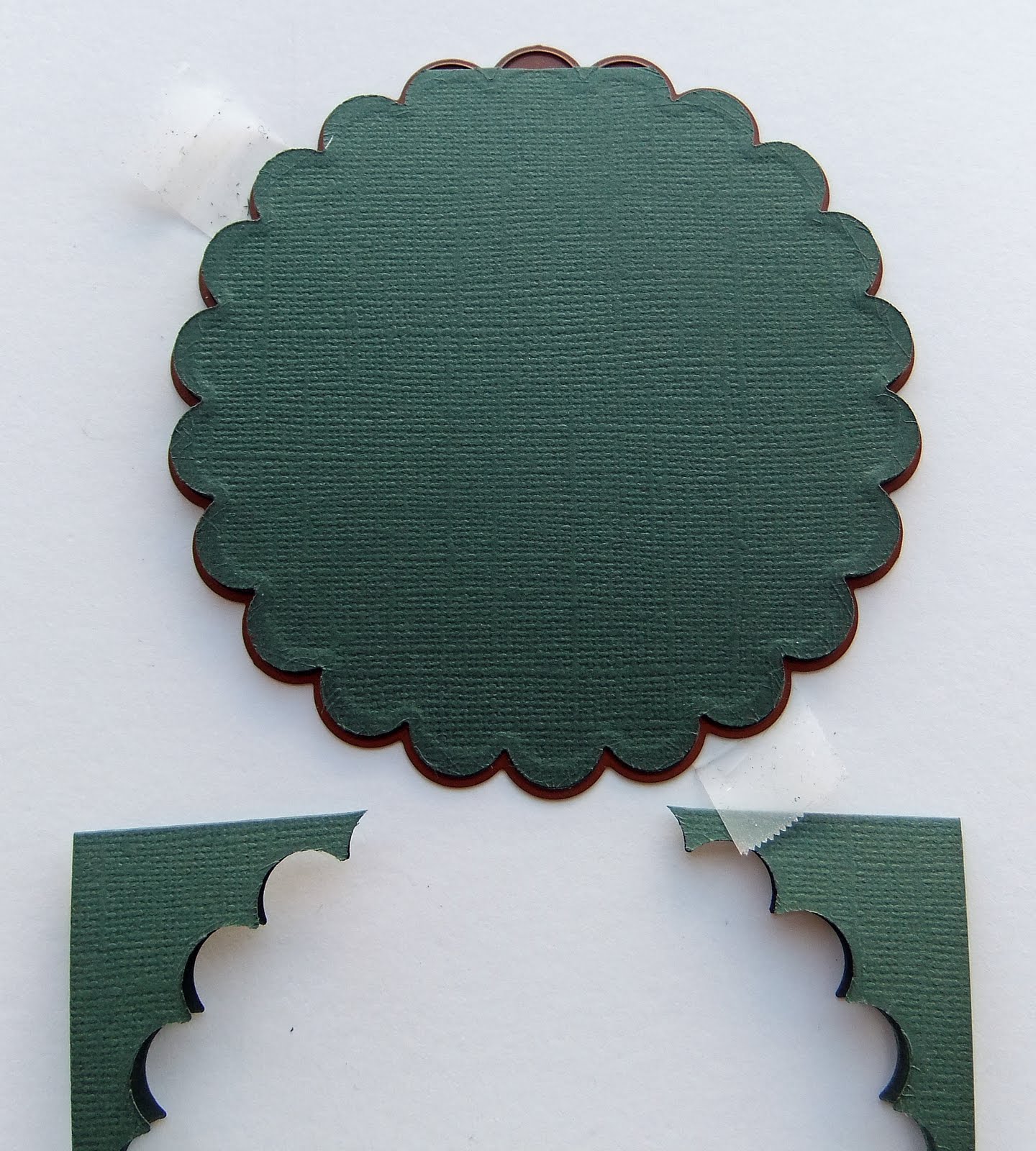
I've glued the DP's and cardstocks together as shown below.
I will call these circle #1 for one shown on the left and circle #2 for the one at the right side.

Take circle #2 and place it over the bottom section of the easel card, lining up the scalloped edges. Determine where you're going to place your brad--centered, near the bottom.

X marks the spot...

Take your piercing tool and make a hole here.

Take circle #1 and centered it exactly over circle #2.


X marks the spot...

Take your piercing tool and make a hole here.

Take circle #1 and centered it exactly over circle #2.

Make sure it is exactly centered.


Keeping the 2 circles together, turn them upside down.
Take your piercing tool and through the earlier-made hole on Circle #2, pierce through and make a hole in Circle #1 which is the one underneath.

Take your piercing tool and through the earlier-made hole on Circle #2, pierce through and make a hole in Circle #1 which is the one underneath.

Turn right side up and place a large brad through both circles.


Turn the circles upside down again, and place glue at the back of Circle #1.


Glue in place on the bottom section of the easel card.

Now, you have some snipping job to do to the top edges of Circle #2 or else you won't be able to close the card. Fold the top section back and then turn the card over. You will see the overlaps as below.
 Snip off the overlaps as shown here.

Now you can go ahead and decorate the rest of your easel card--the top section and the finishing touches like the sentiments and embellishments.

Now, you have some snipping job to do to the top edges of Circle #2 or else you won't be able to close the card. Fold the top section back and then turn the card over. You will see the overlaps as below.
 Snip off the overlaps as shown here.
Now you can go ahead and decorate the rest of your easel card--the top section and the finishing touches like the sentiments and embellishments.
And there you have it!


 I've used some detail white embossing powder and heat embossed the stamped image to make it really stand out.

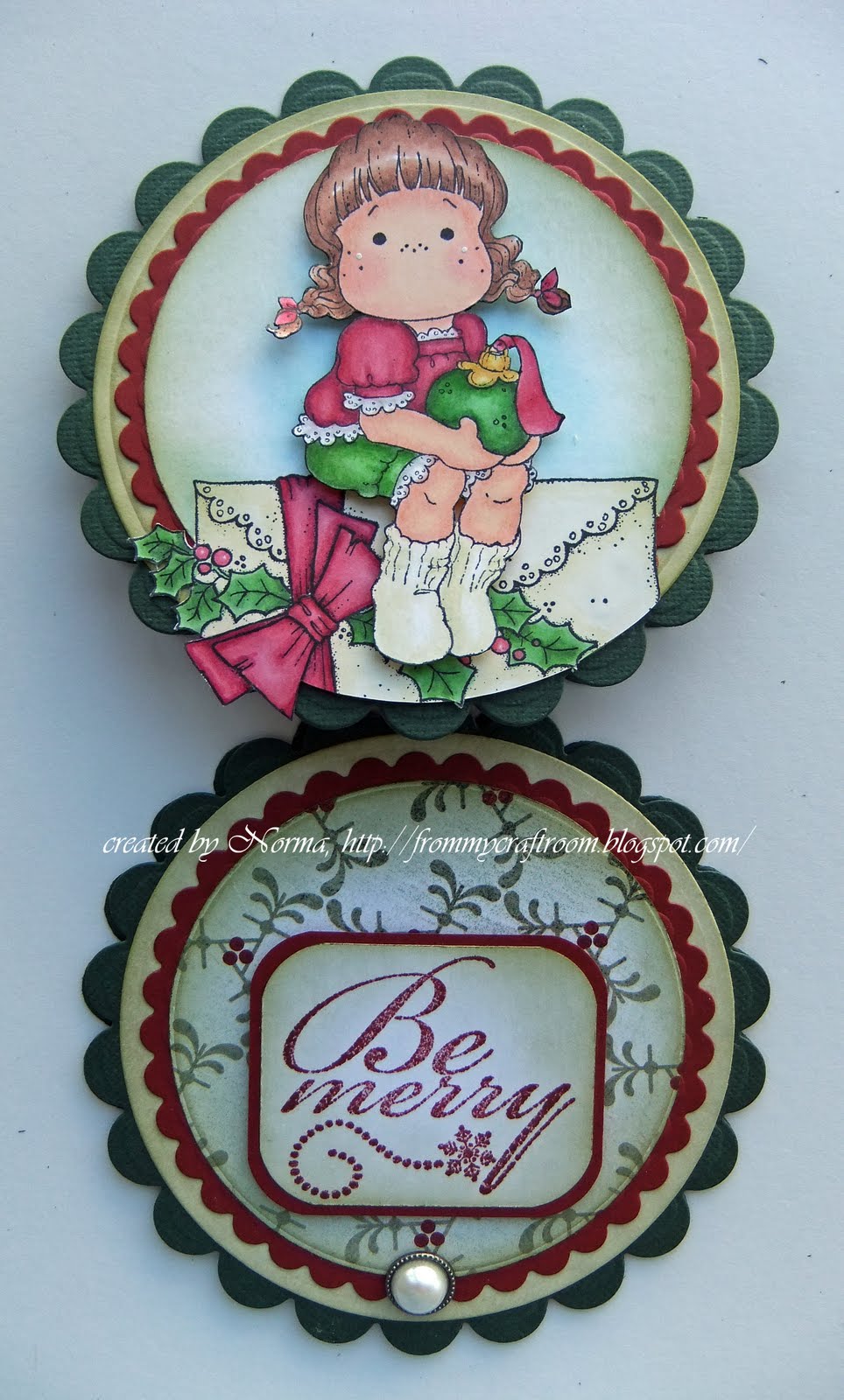
Here's a card I made just for the fun of it. If you don't have time to colour your images, you can simply used a stamped image.

 I've used some detail white embossing powder and heat embossed the stamped image to make it really stand out.
And here's my personal my message to you.....
That's it. Hope this helps. Happy crafting!
PS. Please e-mail me if something doesn't make sense here, so I can make amendments. Thanks.